How Iran will retaliate
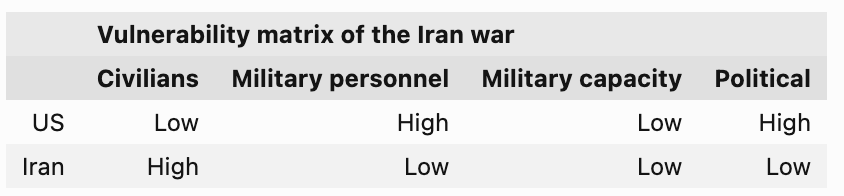
Vulnerability matrix and military strategy

The United States is surging forces to the Middle East, the Journal reported. Special-operations forces have forward deployed to the region from Fort Bragg. More than 150 medics have been moved to the Landstuhl Regional Medical Center in Germany.1 The US is forward deploying more aerial refueling tankers and F-16s jet fighters from Germany, and F-35s from Britain. Heavy bombers have moved from the continental United States to Europe.
While Pape is correct about the signal in logistics, there is a stronger signal of the coming escalation. The Israelis are undertaking civil defense measures in preparation for Iranian retaliation. The signal is stronger because civil defense is costly wasting asset. The mayor of Ramat Gan explained that ‘the risk of missile fire from Iran over the weekend has increased’, so he has ordered that the bomb shelters be made open and accessible to the general public ‘despite the cost’.
We can therefore be fairly confident that a massive US assault is brewing. Trump is frustrated with the lack of options to respond to the blockade of Persian Gulf and the Red Sea. He cannot forcibly reopen either. The war of the sieges is unlikely to yield a favorable decision over any horizon he can tolerate. And now Iran has started killing American troops.
Trump has threatened to attack Iranian bridges and power plants again. One would think that the Iranian response to an American counter-value assault would be simply retaliation in kind. But there are good reasons to think that Iranian strategy has evolved in a more aggressive direction.
In order to understand Iranian grand-strategy, it pays to think a bit systematically about vulnerability. Here’s a simple vulnerability matrix to fix ideas. The vulnerability of US civilians to Iranian attack is low. They are located too far for Iranian missiles to reach. Iranian civilians on the other hand, are highly vulnerable to US attack.