The Geopolitical Consequences of Defeat
What happens after the US loses

When a student of world politics says the world is unipolar or bipolar, that is a hypothesis about the polarity of the world. The wager of a unipolar world hypothesis is that there is no state in the international system that can put up a fight with the strongest state in the system. If a state does, in fact, put up a real fight with the strongest state in the system, then the hypothesis of a unipolar world has to be rejected.
As I argued in the previous dispatch, the US is facing strategic defeat. I did not say that US defeat is certain. I said that a strategic defeat is not only a real possibility but the central scenario.
Specifically, if the US cannot suppress Iranian attacks across the gulf, if it cannot forcibly reopen the strait of Hormuz, that would constitute a strategic defeat for the United States. It would prove that the world is not unipolar, bipolar or tripolar, but rather multipolar, with Iran as a real pole of the international system. What will be the geopolitical consequences of this stunning turn of events?
Before we get to that, let me restate the case so that the load-bearing parts of the argument are clear.
The only way in which the United States can evade outright defeat is by suppressing and degrading Iran’s ability to hold gulf assets at high levels of risk and keep Hormuz closed.1 If the US cannot, through either the direct application of force or indirectly through military coercion, accomplish this strategic objective, the outcome will be indistinguishable from strategic defeat, even if the war ends in a ceasefire, for then Iran would’ve demonstrated for all to see that the United States does not, in fact, have the military means to impose its will on the gulf.
This means that the dynamics of the interdiction campaign are decisive.
If the interdiction campaign rapidly degrades Iran’s ability to attack gulf assets, that would still not guarantee victory, however. For victory requires the further success of countermining operations if the Iranians mine the gulf, as they have reportedly started doing. Countermining operations are not a solved military problem either. At the very least, they will also take many months. What is clear is that, a successful prosecution of the interdiction campaign to conclusion is a necessary condition for effective countermining operations.
What I showed you in the previous dispatch is that, even under fairly rosy assumptions, the interdiction campaign will take many, many months; long enough to impose prohibitive costs on the world economy and the Trump presidency.
Time is Iran’s great power ally in this struggle.
The longer this war lasts, the greater the costs that Iran can impose on the United States and the world economy. This cost imposition strategy would succeed if, in the perception of future American presidents, the costs of attacking Iran again are seen as prohibitive, for then Iran would’ve secured its principal war aim of restoring deterrence.
Since I wrote that piece, there have been a number of revisions of our picture of the interdiction war.
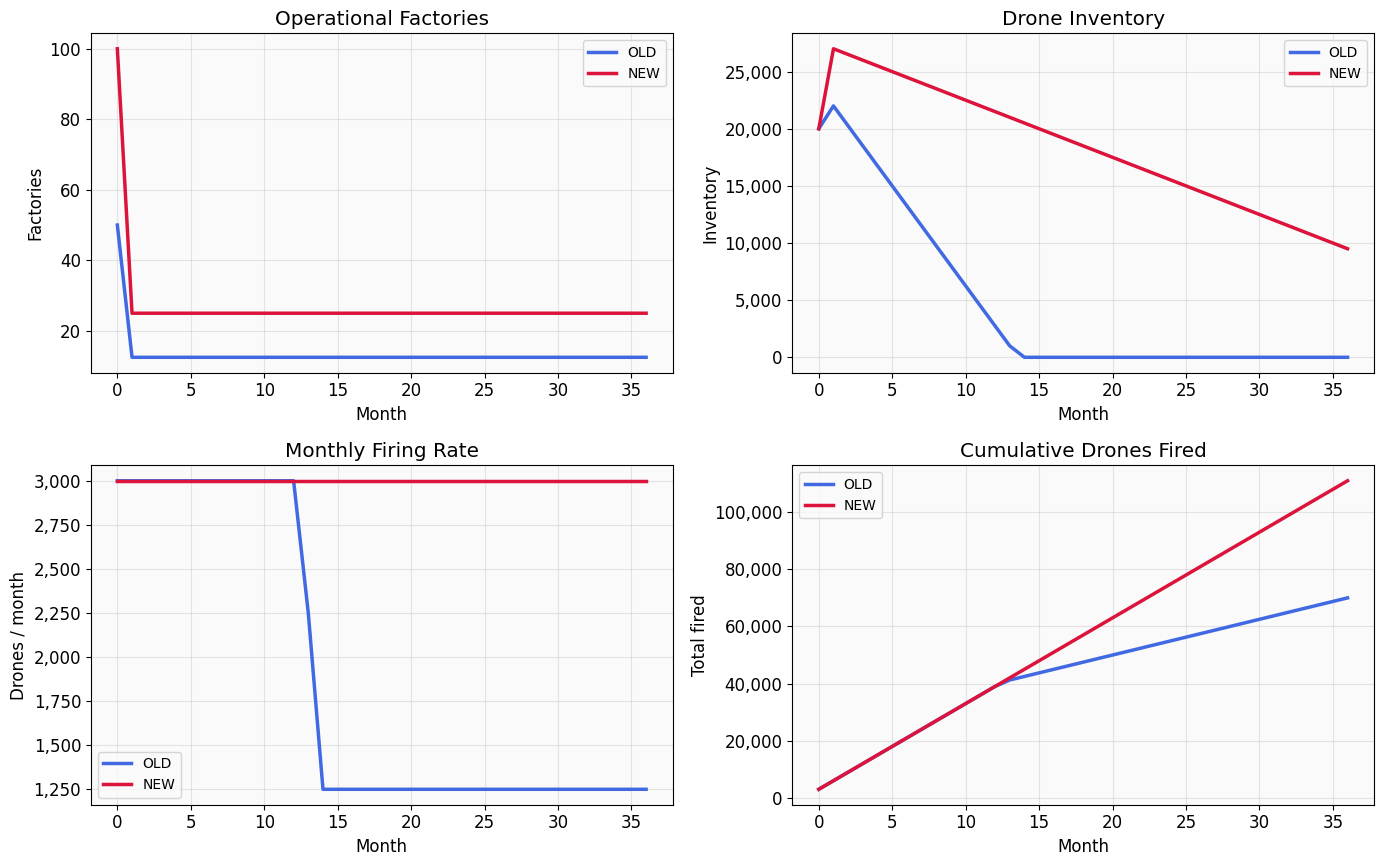
One of the key assumptions of my analysis was that Iran could produce 5,000 Shahed drones per month, in line with the secret Russian assessment reported by the respected German newspaper, DW.2 That turns out to have been too rosy. Reuters has since reported that, according to the Centre for Information Resilience, a non-profit research group funded by Britain’s Foreign Office, “has the industrial capacity to produce around 10,000 per month.”
The next figure shows the impact of changing this specific assumption.
According to the previous baseline scenario premised on a prewar production rate of 5,000 per month, Iran could be expected to sustain firing 100 drones per day for a year. Given a prewar production rate of 10,000 per month, Iran can be expected to sustain firing 100 drones per day for more than three years.3
A second revision is related to new estimates coming from the Pentagon and the IDF. They suggest that little progress is being made in taking out missile launchers. The reported percentage of launchers destroyed is still 60%, unchanged from the end of the first week of the war. This means that either interdiction is proving harder than hitherto believed, or that there have been upward revisions in their estimate of Iranian launcher inventories.
A third revision is in the estimated inventories of Iranian missiles themselves. The figure available previously was an IDF estimate of 2,500 missiles. Turns out, that is an estimate of only missiles capable of reaching Israel and excludes SRBMs that can be used against targets in and across the gulf. The size of the SRBM inventory is unclear. Iran Wonk reports a range of 6,000-8,000, according to Israeli estimates.
A fourth revision of our picture of the interdiction war is related to the production cost of the Shahed drone. Esfandyar Batmanghelidj estimates that they cost a fifth of as much as previously believed, a mere $7,000, which is also a fifth of the production cost of the American knock-off. He also reports that the Iranians have completely indigenized production of the drone, including the motors; suggesting a high capacity for reconstitution.
A fifth and final revision is related to the impact of Iranian attacks on US radars on the interdiction war. The Iranians have successfully destroyed the billion dollar AN/FPS-132 radar installation at Al-Udeid base in Qatar. They also stuck a TPY-2 radar attached to a Thaad battery in Jordan. Three radar domes at Camp Arifjan in Kuwait have also been stuck. Yet another radar was destroyed at Prince Sultan Air Base in Saudi Arabia.
The attacks on radars systems have no doubt degraded US battlefield reconnoissance, meaning that fewer launchers, storage sites and production sites can be identified. Meanwhile, Iranian attacks on US air bases have made them unusable; sharply reducing the sortie rate to what can be sustained from faraway bases and carrier navigation.4
These revisions suggest not just that the rate of interdiction may not be high enough to force the inventories to zero within a tolerable number of months (d > r, but not d >> r). They suggest rather that Iranian inventories and strike tempo of these drones and maybe even missiles may instead grow from here (d < r).
The upshot of is that Iran may be able to hold the gulf at risk and Hormuz closed considerably longer than previously believed — years, not months. There is also a real possibility, not just nontrivial but with considerable probability mass, that the interdiction campaign fails outright — that Iran’s ability to hold the gulf at risk increases from here.
What, then, are the geopolitical consequences of an Iranian victory?
