Retrenchment Masquerading as Escalation

News of the kidnapping set off a cottage industry of takes by journalists, academics and opinion makers. Three of them stood out.
The first was the celebratory Washington Post editorial: “This is a major victory for American interests.” The unusual stance signaled the takeover of large parts of the media institutions by the tech oligarchy. The Post was one of the first to be bought by the new money. Others were even more significant, starting with Elon Musk’s purchase of Twitter. But Musk’s bid for power pales in comparison to what has been afoot elsewhere.
Larry Ellison bought CBS and installed Bari Weiss, who has no experience as a reporter whatsoever, as its chief editor. His struggle to acquire HBO and CNN is ongoing. And most important of them all, he bought TikTok with the administration’s help. Bibi called it ‘the most important purchase that is going on right now.’ Ellison, a major donor of the Friends of the IDF, plans to make further acquisitions to counter the evaporation of the pro-Israel consensus after the genocide.
The second was the little debate that unfolded over Venezuelan oil. Javier Blas laid out the oil primacy view. “Today the White House has primacy over oil-producing allies and adversaries alike — whether it’s Saudi Arabia or Iran, Nigeria or Russia. … The country’s oil is now part of a petroleum empire stretching from Alaska to Patagonia — all under Washington’s tutelage.”
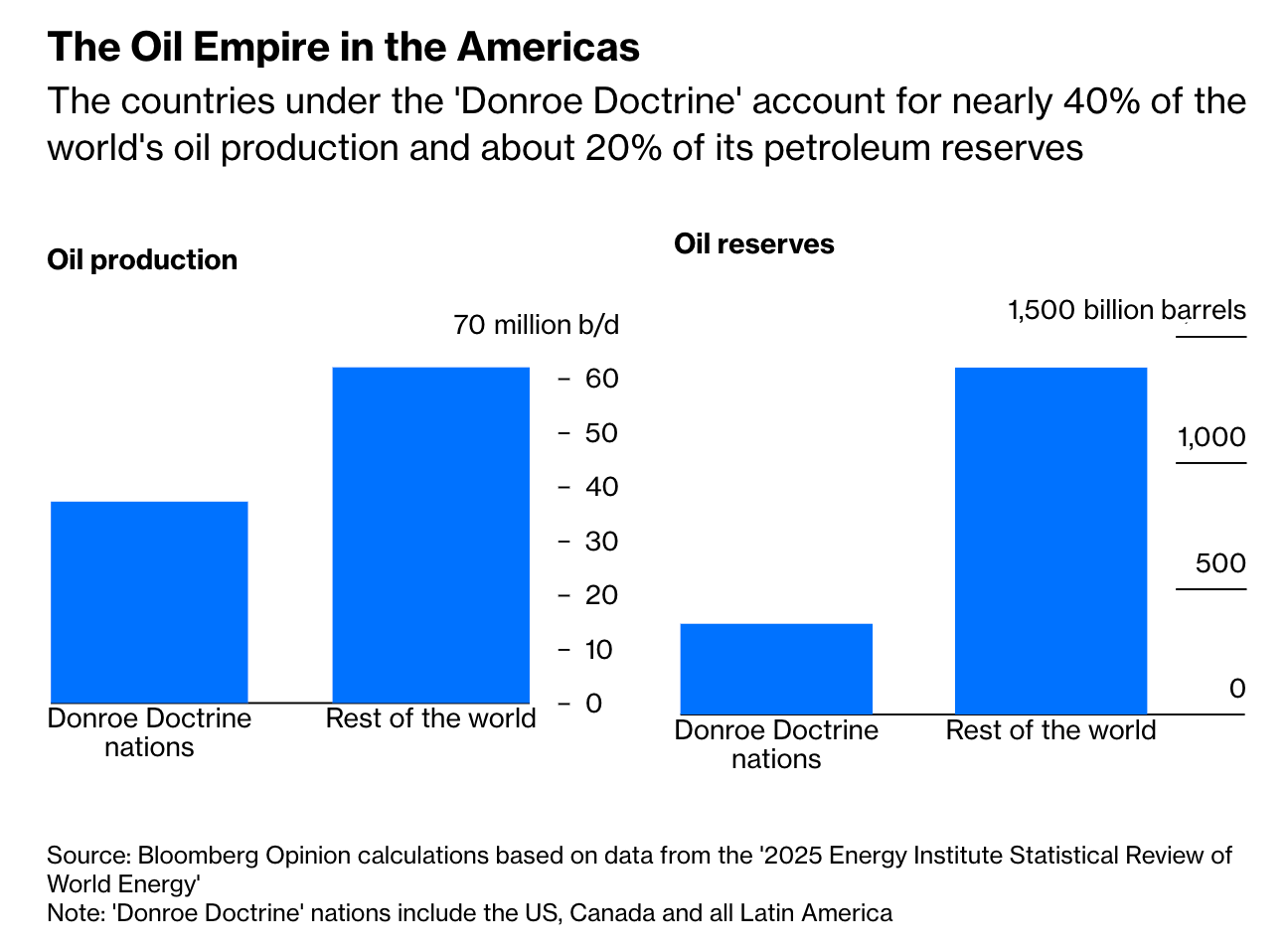
Kartik Sankaran begged to disagree, pointing out that the oil market is already at risk of oversupply and that Venezuelan crude would undercut the profits of US frackers. Adam Tooze noted that Venezuelan heavy crude is costly and difficult to extract so that ‘technically recoverable’ is very far from ‘economically recoverable’. The oil majors invited to the White House were not happy, with Exxon telling the White House that ‘Venezuela is uninvestable’.
I think both sides of this debate have a point. On the one hand, Venezuelan crude is indeed costly and difficult to extract and the oil majors are not keen on developing the fields without substantial ‘de-risking’ and assurance of US policy stability. On the other, control of Venezuelan oil does give the US a veto over third parties’ access to those gargantuan deposits.
The third was related to the revival of the Monroe Doctrine; the clearest statement of a declared sphere of influence in the modern period. Greg Grandin’s historical note on the doctrine is well worth reading.
In the 19th century, politicians cited the Monroe Doctrine as a war cry, used to justify the annexation of Texas, the seizure of around half of Mexico, the removal of Native Americans from their homelands, the acquisition of Puerto Rico and the occupation of Cuba. In 1898, the populist William Jennings Bryan proposed extending Monroe’s “shield” around the Philippines, to legitimate annexing that Asian archipelago.
Greg Grandin, Financial Times, Jan 9, 2026.
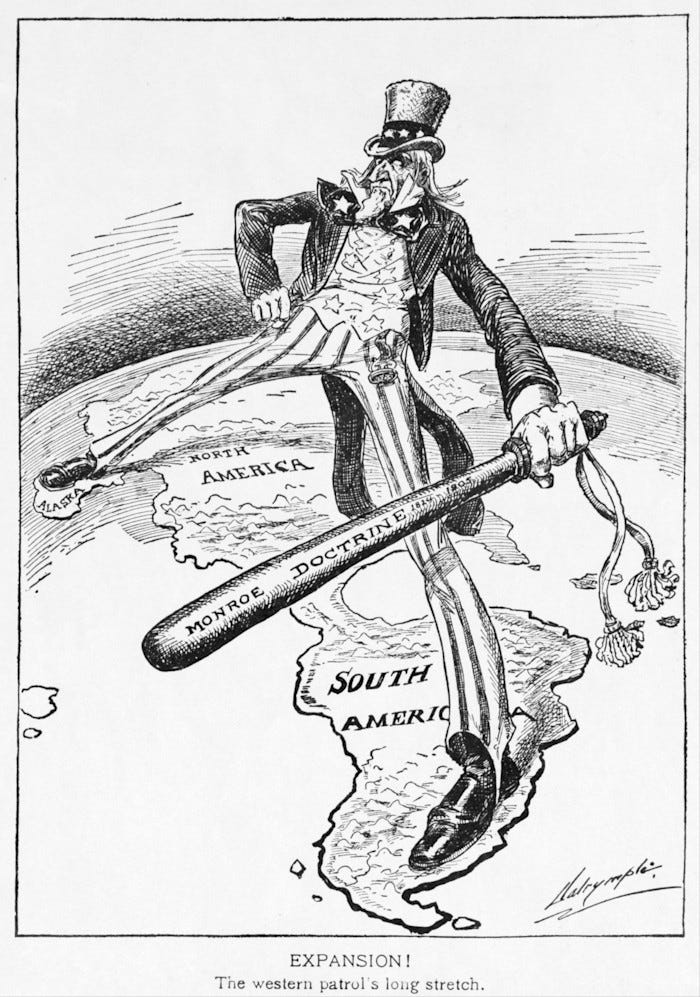
The hard core of the Monroe Doctrine is the exclusion of the Old World powers from the New World. The US was not in a position to impose this principle until the turn of the century when, in the midst of a confrontation with Britain over Venezuela, the Secretary of State spelled out the new strategic situation.
To-day the United States is practically sovereign on this continent, and its fiat is law upon the subjects to which it confines its interposition. Why? It is not because of the pure friendship or good will felt for it. It is not simply by reason of its high character as a civilized state, nor because wisdom and justice and equity are the invariable characteristics of the dealings of the United States. It is because, in addition to all other grounds, its infinite resources combined with its isolated position render it master of the situation and practically invulnerable as against any or all other powers.
Secretary of State Olney’s note to US Ambassador to Britain Thomas Bayard. July 20, 1895.
The exclusive sphere-of-influence principle is understood to be strategically sound and has never been abandoned. The security implications of foreign meddling in America’s backyard became manifest with the Zimmerman Telegram, an intercepted secret 1917 diplomatic note from Germany to Mexico proposing a military alliance against the United States. Wilson managed to persuade Americans to join the European struggle in large part due the outrage it caused.
The most the US was ever willing to tolerate was the Russo-Cuban alliance during the Cold War. Despite the Bay of Pigs fiasco, Kennedy again ordered Lansdale to conduct clandestine operations to remove Castro from power; all of whom failed. When the Russians started installing nuclear missiles on the island, the US threatened to exterminate six hundred million people in ‘a full retaliatory response.’ In the aftermath of the nuclear crisis, the US agreed not to invade the island. The island was instead subjected to relentless economic warfare unsurpassed in duration and punitiveness.
A corollary of the exclusive sphere-of-influence principle is that the US will not tolerate confrontation regimes in its backyard. For if ex-hemispheric powers are to be effectively excluded from the hemisphere, then the US must control the foreign policies of all states in the region. In particular, revolutionary regimes can create openings for ex-hemispheric great power adversaries and therefore cannot be tolerated.
Every administration since at least George W. Bush has attempted to remove Chávez and then Maduro from power. As Dov Levin notes, through the NED, the Bush administration funded an extended campaign to first recall Chávez and then to defeat him in elections. When the recall effort failed, Bush sent campaign advisors and financed the Rosales campaign. Obama intervened in the 2012 and 2013 Venezuelan elections in favor of Capriles. Trump I tried to encourage a military coup against Maduro and launched covert operations to overthrow him in 2019. When that failed, Trump resorted to a Bay of Pigs-style operation to remove Maduro. Biden for his part conditioned removal of sanctions on elections, hoping that he would be removed through the ballot box.
The spectacle of the kidnapping and of the unrestrained big-fish-eat-small-fish discourse of the Administration (“These are the iron laws of the world since the beginning of time,” as Miller put it) has generated a lot of heat and light. Central to the froth was the idea that Trump has finally been revealed to be an imperialist. I find the whole thing a bit over the top. The continuities of US policy both regarding Venezuela in particular and Latin America in general seem rather more striking to me.
The strategic rationale of the Monroe Doctrine remains as compelling as ever. The principal objective of the kidnapping was to tame a confrontation state in America’s backyard that was in cahoots with America’s adversaries. Cuban, Russian and Chinese influence has been curtailed by a controlled-yet-decisive use of force. If the oil majors are unhappy with what has been thrust on their shoulders, they will just have to suck it up.
But this was not the only objective. The other was rent-seeking. On that front, I found Goddard and Newman’s neo-royalist model quite compelling. “From a neo-royalist perspective, the trade war is a rent-seeking strategy, a regime based on arbitrary decisions, aimed at extracting maximum wealth for the clique.” With his oil empire, Trump has unlocked a stupendous source of rents for his cronies.
As I wrote in the aftermath of the US strike on Iranian nuclear facilities, Trump threaded the needle by choosing the least escalatory option offered by General Kurilla, the aggressive, pro-Israel commander of CENTCOM. Perhaps he does not have a coherent strategic doctrine, but he does seem to have a coherent tactical doctrine: quick, carefully-designed, precisely-targeted military operations to secure immediate US interests, minimize risk, and demonstrate capabilities. And he is not afraid to shut down operations when the costs begin to bite, as happened with Kurilla’s failed month-long campaign to bring the Houthis to heel which turned into a fiasco with the US losing multiple front-line combat aircraft under fire.
Trump’s clear penchant for this tactical doctrine does not seem consistent with expansive ideas of nation-building or any kind deep intervention anywhere. This is partly why I have been so skeptical of the idea that the US will get bogged down into a quagmire in Venezuela. Not only is Chavismo exhausted as a mass movement, Trump II does not seem inclined in the least to conduct any kind of deep operation on the country and its structures of power. He is more than happy to keep the now sufficiently-intimidated regime in place, as long as they give him what he wants.
I do agree with Ed Luce that Trump is serious about taking Greenland. But the island has been under US military control since World War II. So, the goal cannot be military security; that’s just an excuse. The real agenda is control over resources, the rights to extract them, and the authority to assign those rights—in line with the Goddard-Newman neo-royalist model.
Given how craven the Danes were re Gaza, I cannot be bothered to shed a tear for their imperial property. It’ll be good for them to learn a thing or two about the reality of international law.
There is a deeper issue that everyone seems to have missed. All this grandstanding and spectacle, this open embrace of the mafia principle, is—consciously or subconsciously—a cover for a policy of retrenchment.
The tariff wall signals that the Administration has given up entirely on the idea that American firms could compete out in the open with the Chinese. Best to simply put up a great wall of protection and return to the national container, surrendering the world market to China. The gutting of USAID and the termination of US participation is a slew of international organizations signals a near-total withdrawal of the US from any responsibility for managing the international system. The Europeans have been told that they should be prepared for a US exit by 2027. Above all, the US defeat in the confrontation with the Chinese over trade policy laid bare the limits of US economic power for the whole world to see.
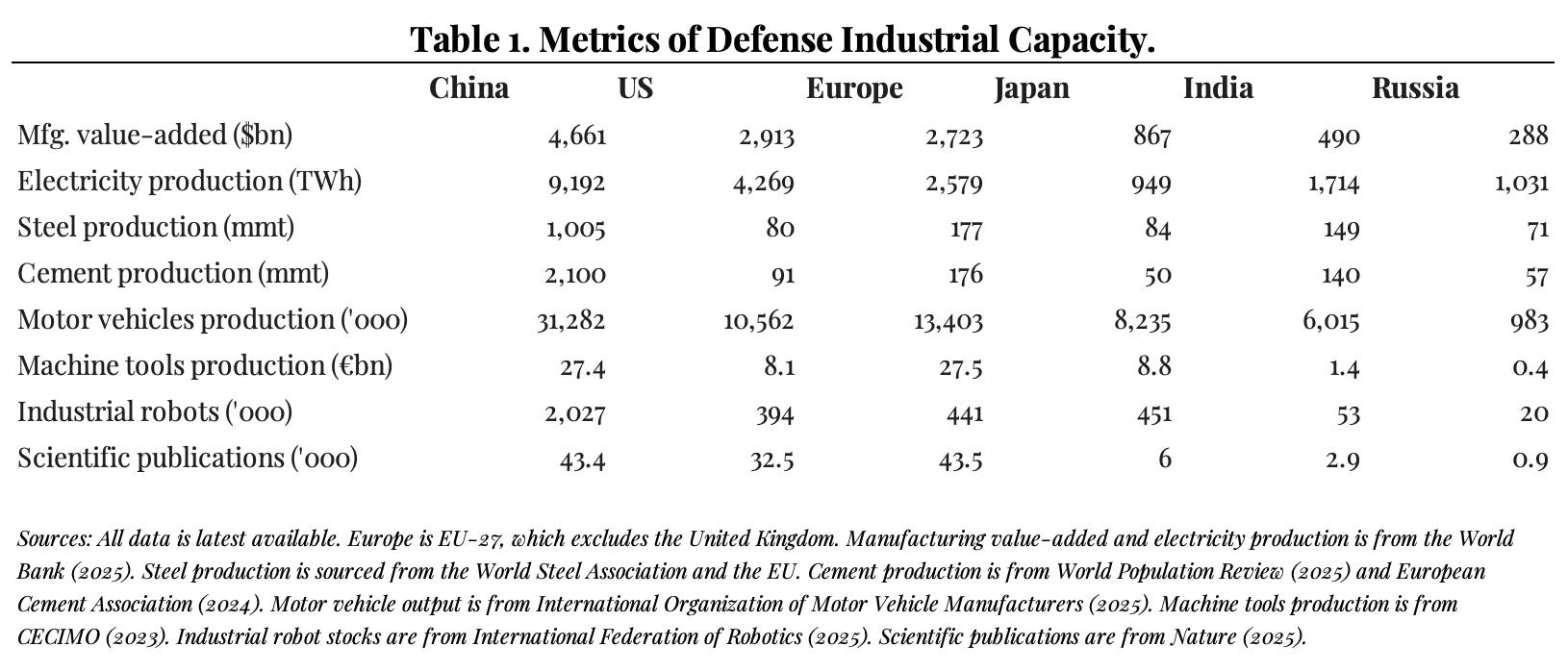
Looming over everything is the sheer scale of China’s defense-industrial potential. China’s manufacturing value-added is 1.6X America’s, electricity output is 2.2X, steel production 12.6X, motor vehicles output 3.0X, machine tools 3.4X, industrial robot inventory 5.1X, scientific output 1.3X. It is really hard to see how the US can avoid outright defeat in any sustained military struggle anywhere within China’s orbit.
This problem is especially acute because the US is the strategic defender in Asia. This means that China will have the strategic initiative and all the advantages inherent in that position: the luxury of a meticulously prepared offensive in the manner of the Israelis; the possibility of a highly-advantageous strategic surprise studied by Betts; Hitler’s strategy of a time-table war of aggression, with the attack timed precisely to the peak of military preparations.
In effect, time-table war is the application of the military principle of force concentration to the time axis. It represents the ultimate expression of the aggressor’s first-mover advantage, allowing him to launch his entire economic and military potential at a predetermined moment of his choosing, timed precisely to the peak of military preparedness.
Policy Tensor, The Problem of the Strategic Defender.
The unfavorable balance of power potential and the problem of the strategic defense sum up to a very disturbing strategic outlook for the United States. These realities cannot fail to cast their shadow on international relations. And indeed, one can see why Trump would be so accommodative of the Chinese, why he would want to negotiate a far-reaching modus vivendi with them, and why he would embrace a policy of retrenchment. Simply put, the Chinese economic miracle has created an entirely new strategic situation that has opened up a chasm between the means and ends of US military and security policy.
Trump’s policy of retrenchment is a more serious attempt to solve the problem than the AI fantasies of the Biden White House. The spectacle of the hemispheric turn in US policy seems to me to be a cover for much bigger revisions of US foreign policy underfoot.
Yet to be convinced that Trump admin can coherently organize policy around strategic logic, however sound it may be in theory. Specifically, I think they lack the discipline and restraint that would be required to execute a hemispheric strategy.
They're running with incremental but very aggressive actions in quick succession, because they think they're getting away with it. This is true domestically too, as ICE emerges as an organ of internal repression, perfectly in the mold of classic fascism. In some sense they really are getting away with it, on other ways they'll lose Asia that much faster by burning down what remains of their trust and reputation outside of the US itself. China hitting Japan pretty hard with sanctions now - and what's anyone gonna say? Rules based order & free movement of goods and capital? There was a time the US-supported dictatorships could make the argument of being the lesser of two evils. That time is fully over. At the same time, the US is killing off any middle ground (ie neutrality). That would leave one option that everyone can see - an anti-US coalition. I would suggest that the US will be more successful in killing off the viability of the neutral position, than stopping a coalition forming against it.
I think we're looking at a near term of more desperate intimidation gambits, which will result in more and more conflict.
Very good analysis!